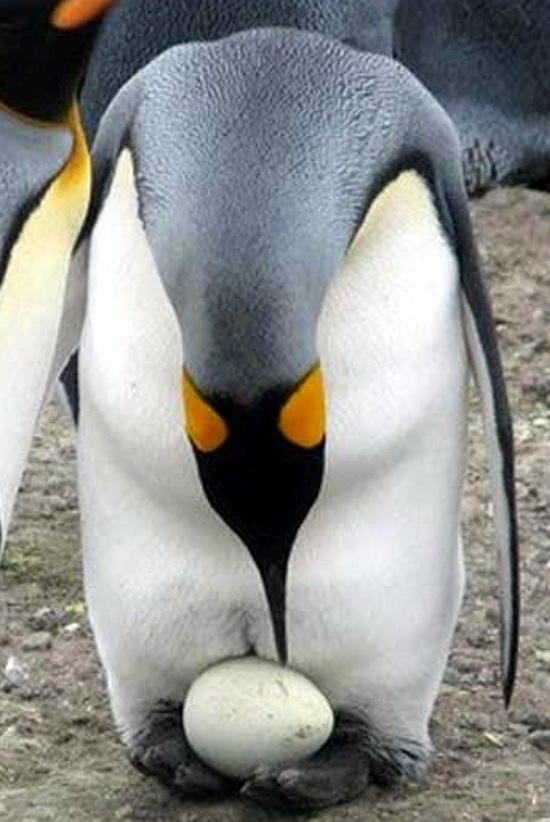
The Egg
Janet Mason
Jamie was still thinking about penguins when she walked into her last class of the day at the small, private college where she taught basic physics.
The thought of the emperor penguins possibly going extinct was exceedingly sad, but it was better than thinking about the heat wave they were in – when it wasn’t even summer yet, the wildfires on the West Coast, or the quality of the air that was causing her to cough. The emperor penguin was just one species in what some scientists predicted would be as high as three-quarters of the species on Earth in what was called the sixth mass extinction, already being hastened badly by human behaviour. Jamie glanced at the smattering of students, rising before her in the wooden seats of the lecture hall. Standing behind the lectern, she looked down at her watch. She had almost five minutes till class started. She lifted her gaze and blinked slowly at the students sitting in front of her.
The possible fate of the penguins means our class project is more important now than ever, she thought.
She was wearing a white cotton blouse that was usually tight over her midsection. But now that she had been on a healthy vegan diet for longer than a month, she had a flatter belly, and her shirt fit better. She had commenced on a totally plant-based diet after one of her students pointed out that she needed a reason to come to class based on what some scientists were predicting that some regions would become uninhabitable by 2050.
Jamie did the maths. Most of her students would still be under fifty at that time. After she said this, the same student quoted an Oxford University study that said going to a plant-based diet was the single most important thing to do to help the planet become more sustainable. After class that day, a colleague mentioned that she had just learned that the emperor penguins were expected to go extinct in less than a century. That jolted Jamie into going to a completely plant-based diet that evening. It was her feeling for the penguins that sealed the deal. However, she also had to face her students almost every day and be part of the solution to their need for a habitable planet to live on. She felt better than she ever had – even after a month of being vegan. But her health had been an afterthought.
Looking down again, Jamie put her hands in the front pocket of her blue jeans. She imagined that her white front was fleecy soft and made from short white feathers that grew all the way down to her feet.
In her imagination, her feet were webbed and dark with three prongs on each one of them and sharp nails at the end so that she could grab the ice as she walked. Her belly was especially large and soft. She looked down and saw that her white feathers draped over her feet. When she stretched so that she was extra tall, she looked down and saw that an off-white egg was resting on her feet. Then she realized that since the males watched over the eggs (while their female mates spent the winter hunting for food in the sea), this meant she was a male penguin.
It's fine by me to be male, she thought. Gender is a social construct anyway.
It was likely that she thought this way because she had come out as Queer later in life. Technically, at least. She thought of herself as technically queer because, for the most part, because she really didn’t like either gender. She preferred being alone. But her longest relationship (eight months) had been with a woman, Sylvie, right after she had come out a few years ago. She had read that male penguins gave the egg to a female they wanted to mate with. This left her wondering. If she were really a penguin with an egg, who would she offer it to?
Sometimes, when Jamie had to fill out a form at a doctor’s office, she made her own box and labelled it other and checked it, rather than the box for female or male, just to mess with people’s heads.
But she was confused as to why she was imagining herself as a male penguin with an egg. She wasn’t a kid person, and she didn’t think that would change if she were a penguin. In fact, if she were a penguin, she hoped she would march away from the group of other penguins on a solitary trek over an icy hill. Penguins seemed to be social creatures, but not her. She always wanted to be doing her own thing, penguin or not.
Jamie heard a rustling and looked up. More students were coming into the room and filling the chairs.
It must be getting close to the time when class will start, thought Jamie as she looked down and checked her watch again.
With two minutes until class began, her imagined feathers had dropped away. She was just a human teacher in a white button-up shirt, trouser-cut, stretchy blue jeans, and nebula-blue nonslip low-cut sneakers. As she continued to look down, she saw that she wasn’t standing on ice. Instead, she was standing on the hardwood floor of her classroom.
It occurred to her that she had been in a waking dream. The egg that she had imagined herself protecting as a male penguin was something special. It was a new birth, but it wasn’t a chick—or maybe it was. The egg represented a way forward. It was the class project. The students had decided to do a class project to prove with physics that a plant-based diet could help the planet. Done right, this class project could help change the world. It could give the penguins more time.