Growing Pains
Alia Jenkins
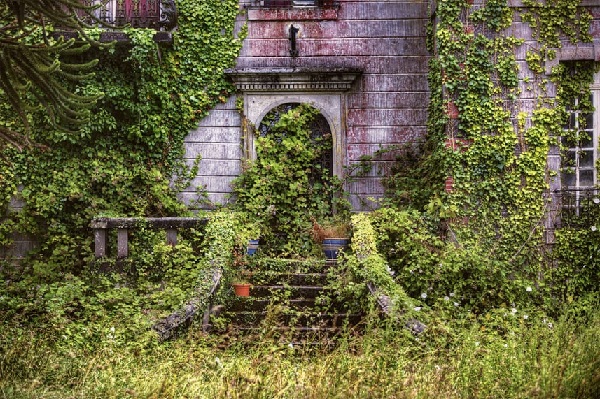
The ivy was out of control, she knew. She had watched it creep for years. When she was younger, she would beat it back, but now her home looked like a fairy-tale facade. There was nothing she could do about it. The groundskeeper had long ago abandoned his post, his bones failing him after years of toil and there was no replacement available in the village. The young, when going it alone, had moved to the big cities to pursue big dreams. Those who did exist in the village had moved from the big cities, their big dreams attained and were able to work remotely - making them thoroughly unsuitable for garden work.
She had not been able to walk in her garden (or walk at all) for many years. It was not only the steps that posed a hurdle, but also the jungle of ivy that had twisted around the handrails, slithered up the stairs, and choked the life out of the roses. There was just no way for her to get there without growing wings and smiting it with holy fire.
She looked further out to the fields and rolling hills, remembering the feeling of the tall grass slapping at her bare legs as she ran. She would sneak past her parents and out the back gate wearing nothing but her wellies. She could zoom around for a glorious ten minutes (if she was lucky) before they noticed that she had gone missing. On the way home, the grass dragged across her skin while she hung her head and stomped all the way back.
That was a lifetime ago, before the ivy. This house, these fields, they had always been the place she had called home. After her parents had died and her sisters had married and moved away, it had been just her in the house. She was alone but never lonely. For an occasional fleeting moment, she regretted staying unmarried, not for the company, but for the pension. Extra money would have allowed for someone to take care of that abominable ivy. But marriage would have come at the cost of a lifetime of freedom, and that was an unacceptable price to pay. Yes, it was better this way. Better for the ivy to take her brick by brick. Better to be alone and free.
Her sisters had seen to continuing the bloodline by birthing enough children to populate a small town and she was glad not to have to contribute to an overpopulation issue. Despite her adoration of silence and solitude, she also adored her nieces and nephews. They visited as often as they could, but life gets busy and they had little ones of their own to take care of. Nevertheless, as she aged, they had ensured she got the care she needed.
That care came in the form of women demolishing her peace three times a day to cook, ‘clean’, and make sure she had a wash. The infantilisation drove her to distraction. She had not yet lost her sight, hearing, or mind, only the use of her legs. Yet they bustled in and out, bossing her here and there, demanding she eat on their schedule. Some days she refused to eat at all just to assert some autonomy.
Now, what was it that she was wanting to do? Ah yes, the ivy. That was it. It had snuck up the walls when she wasn't looking and was now trying to slither in through the window. Maybe if it grew a little bit more, she could reach the tip and pull the whole thing away from the wall.
It's a pity the carers can't do the gardening. That would certainly be more useful. They could hack it all back and then she would be safe from it for a few more years. She had tried asking them but was met with "We only have half an hour" or "Health and Safety". What nonsense. They won't die from a bit of hard labour. It's not as if they do much else in their half hour. Imagine what a difference an hour and a half of gardening every day would make. They could do it while the food was in the oven rather than playing on their silly little phones.
There's a bench in the garden, not that you can see it under the mountainous ivy. She wondered if it could still bear weight. Probably not. The tendrils would have seen to that, insidious fiend of a plant. She used to sit on that self-same bench with her beloved nieces and nephews. They looked after her so well. She assumed that they paid her so much attention because their own parents were no longer around. She was wrong about this. They did it because they remembered putting on their wellies and running with the grass slapping against their bare legs, their aunt Bess running alongside them.
She used to think the ivy was beautiful when she saw it winding its way up buildings. She brought a cutting home, and that is how the poisoning began. She did this to herself.
The fairy tales warn you about the big bad wolf, the evil octopus woman, and wicked witches. Why not warn you about the ivy? Why not warn you how, beneath the lush exterior, the ivy sets its spiky vines into the wall, its feet digging into the cement, slowly pulling it apart? That it ties itself around itself so tightly that you can't find where it ends or begins. Describe how it envelops the fence and degrades it, and then, in the end, the only thing holding the pieces together is the bloody romantic-looking ivy.
She could never bring herself to ask any of the family to sort the forest that had developed. They did so much for her already. How could she ask them to clear a garden she couldn't even use?
She rubbed her legs to put some warmth into them. They had wasted away in the years of disuse and were always cold. The house was always cold, but the heating just cost too much. If she had enough money for heating, she would use it to get someone in with a chainsaw.
Scissors! That would work. If she could get right up next to the window and lean out just enough ... but that would be a drop removed from a leafy ocean. Useless.
She sighed and turned away from the window. Well, if the damned ivy wanted to take her, she may as well have it in the flower arrangements. She rolled over to the writing desk and rummaged in the drawer, finally locating and extricating her funeral plans - an ever-growing list of wishes.
A leafy tendril passed her the pen.